Top 5 Breathing Apps with Heart Rate Biofeedback (2025)
Updated March 2025 · 8 min read
Quick Answer
The best biofeedback breathing app in 2025 is MindBreath — it uses your phone camera to measure heart rate via PPG, detects your personal resonance frequency, and shows live RSA visualization of your breathing syncing with your heartbeat. No wearable needed.
Most breathing apps are just fancy timers. They tell you when to inhale and exhale, but they have no idea whether your body is actually responding. A biofeedback breathing app is fundamentally different — it measures your heart rate in real time and adapts the guidance to your physiology.
We tested the top breathing apps across five criteria: real-time heart rate measurement (camera PPG), resonance frequency detection, HRV improvement during sessions, AI-powered analysis, and breathing exercise variety. Here's how they compare.
COMPARISON
Feature comparison table
| App | Camera PPG | Resonance Freq. | Live RSA | AI Analysis | HRV Tracking | Price |
|---|---|---|---|---|---|---|
| MindBreath | ✓ | ✓ | ✓ | ✓ | ✓ | Free / Premium |
| Elite HRV | ✓ | ✓ | ✗ | ✗ | ✓ | Free / $7.99/mo |
| Breathwrk | ✗ | ✗ | ✗ | ✗ | ✗ | Free / $12.99/mo |
| Calm | ✗ | ✗ | ✗ | ✗ | ✗ | $69.99/yr |
| Wim Hof Method | ✗ | ✗ | ✗ | ✗ | ✗ | Free / $5.99/mo |
DETAILED REVIEWS
App-by-app breakdown
1. MindBreath — Best overall biofeedback breathing app

MindBreath is a real-time heart biofeedback breathing app that measures your heart rate through your phone's camera using PPG (photoplethysmography). It detects your personal resonance frequency — the breathing pace where your HRV peaks — and guides you there.
The standout feature is live RSA (respiratory sinus arrhythmia) visualization: you can see your heart rate rise on each inhale and fall on each exhale in real time, confirming your breathing is actually affecting your autonomic nervous system. The “Compare Breathing HRV” mode measures your baseline HRV, then your HRV during resonant breathing, showing the immediate improvement — users see an average 36% HRV increase.
The app includes 50+ breathing techniques — box breathing, 4-7-8, coherence, pranayama, Wim Hof, and many more — all of which can be modified to suit your preferences. You can also create fully custom breathing patterns with your own inhale, hold, exhale, and hold durations. Combined with AI-powered stress analysis, MindBreath is the most versatile biofeedback breathing app available.
- ✅ Real-time camera PPG biofeedback — no wearable needed
- ✅ Live RSA visualization shows heart rate syncing with breathing
- ✅ 50+ breathing techniques, all modifiable + fully custom patterns
- ✅ AI-powered stress analysis and HRV tracking
- ✅ Free tier available, iOS & Android
- ⚠️ Camera PPG requires holding finger on camera during session
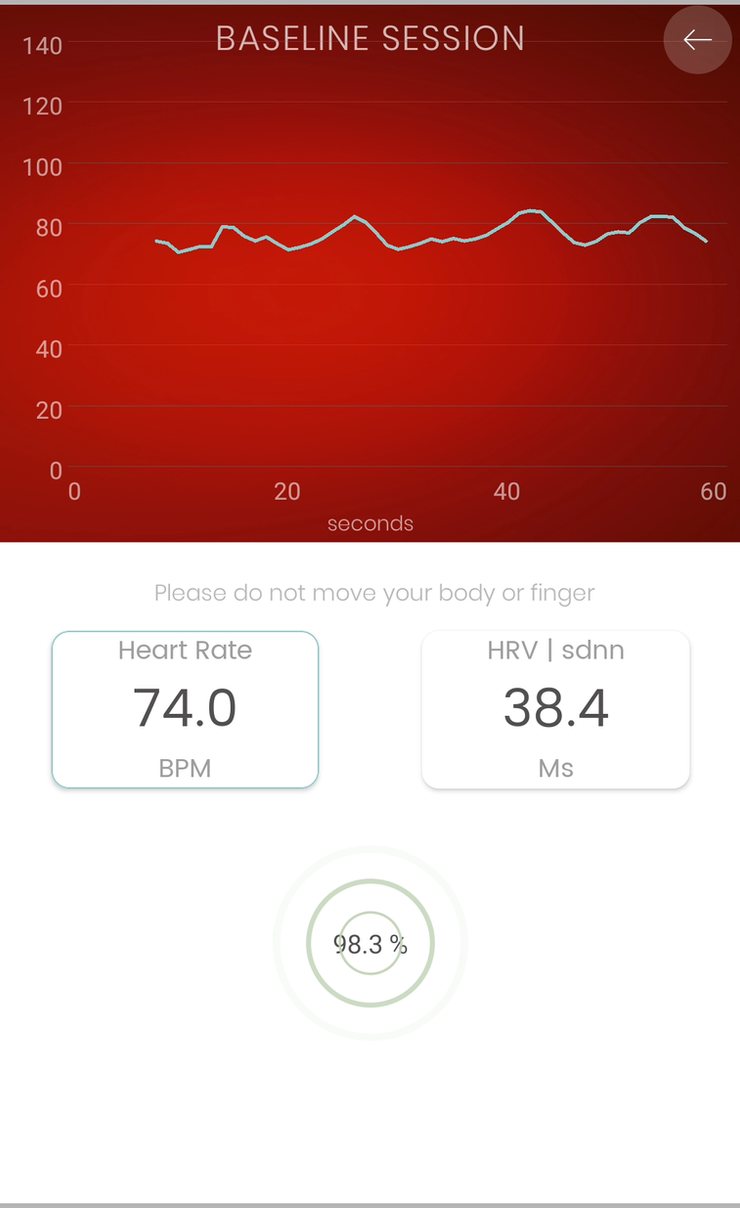
MindBreath baseline session — camera PPG measures heart rate and HRV in real time


Compare Breathing HRV — baseline vs. resonant breathing vs. improvement results
2. Elite HRV — Best for HRV-focused athletes
Elite HRV offers camera-based HRV measurement and a guided breathing feature that adjusts pace based on your data. Good for athletes focused on morning readiness scores. However, it lacks live RSA visualization and AI analysis — you get post-session stats but can't see your heart rate responding to each breath in real time.
- ✅ Camera PPG measurement with resonance frequency detection
- ✅ Good morning readiness scores for athletes
- ✅ Free tier available
- ⚠️ No live RSA visualization during breathing
- ⚠️ No AI analysis or stress tracking
- ⚠️ Limited breathing exercise variety
3. Breathwrk — Best variety of breathing patterns
Breathwrk offers an extensive library of breathing exercises categorized by goal (sleep, energy, calm, focus). Beautiful animations and haptic feedback. However, it is purely a timer-based app — no heart rate measurement, no biofeedback, no HRV tracking. You follow a fixed rhythm with no confirmation your body is responding.
- ✅ Large library of breathing patterns by goal
- ✅ Beautiful animations and haptic feedback
- ✅ Available on iOS & Android
- ⚠️ No heart rate measurement or biofeedback
- ⚠️ No HRV tracking — can't confirm body is responding
- ⚠️ $12.99/mo subscription for full access
4. Calm — Best for meditation + breathing combo
Calm is excellent for guided meditation and sleep stories, with a basic breathing exercise feature. It's a general wellness app, not a biofeedback tool. No heart rate measurement, no resonance frequency, no HRV data. Good complement to a biofeedback app, but not a replacement.
- ✅ Excellent meditation and sleep stories content
- ✅ Polished UI and calming design
- ✅ Wide content library beyond breathing
- ⚠️ No biofeedback or heart rate measurement
- ⚠️ No HRV data or resonance frequency
- ⚠️ $69.99/yr subscription required
5. Wim Hof Method — Best for cold exposure + breathwork
The Wim Hof app guides you through the hyperventilation-based Wim Hof breathing protocol combined with cold exposure tracking. It's a specific protocol app, not a biofeedback tool. No camera PPG, no resonance frequency detection, no HRV measurement. Great for Wim Hof practitioners, but a different category from biofeedback breathing.
- ✅ Structured Wim Hof breathing protocol with rounds
- ✅ Cold exposure tracking and challenges
- ✅ Affordable subscription
- ⚠️ Single protocol only — no biofeedback
- ⚠️ No camera PPG, HRV, or stress measurement
- ⚠️ Not suited for general breathing or relaxation
FAQ
Frequently asked questions
What is the best breathing app with biofeedback?
MindBreath is the best biofeedback breathing app in 2025. It uses your phone camera to measure heart rate in real time via photoplethysmography (PPG) and guides you to breathe at your personal resonance frequency — the pace where your HRV peaks. Unlike timer-based apps like Calm or Headspace, MindBreath adapts to your physiology and shows live RSA (respiratory sinus arrhythmia) visualization so you can see your heart rate rise and fall in sync with your breathing.
Can a breathing app really lower stress?
Yes. Slow, controlled breathing at 4.5–7 breaths per minute activates the parasympathetic nervous system via the vagus nerve. A 2017 meta-analysis in Applied Psychophysiology and Biofeedback found significant reductions in stress and anxiety across 24 studies. Biofeedback breathing apps are more effective than timer-based apps because they confirm whether your body is actually responding to the breathing exercise by measuring HRV in real time.
How does phone camera breathing biofeedback work?
When you place your fingertip over your phone camera with the flashlight on, the camera detects blood volume changes through photoplethysmography (PPG). Each heartbeat causes a tiny change in light absorption. The app extracts beat-to-beat intervals and calculates HRV metrics in real time, then uses this data to find your optimal breathing pace and show you a live visualization of your heart rate rising on inhale and falling on exhale (respiratory sinus arrhythmia).
What is resonance frequency breathing?
Resonance frequency breathing is breathing at the specific rate (typically 4.5–7 breaths per minute) where your heart rate variability reaches its maximum amplitude. This rate is unique to each person. At resonance frequency, your cardiovascular and autonomic nervous systems synchronize, producing a state of physiological coherence that reduces stress, lowers blood pressure, and improves emotional regulation.
Do I need an Apple Watch for biofeedback breathing?
No. Apps like MindBreath use your phone camera (PPG) to measure heart rate and HRV — no wearable required. You place your fingertip on the camera for 30 seconds to a few minutes during a breathing session. This method is validated in peer-reviewed studies and produces accurate beat-to-beat intervals comparable to chest-strap ECG monitors.